We love all sorts of games. Sometimes it is hard to cover a game in our traditional review style, which is why we have tidbit-style reviews. These shorter reviews cover games that deserve attention too, but simply don’t fit our good, mixed, and bad template.
- RACCOIN: Chaos Max Edition | Score 69%
- Developer | Doraccoon
- Publisher | Playstack
- Available on | Xbox X/S, PlayStation 5, Nintendo Switch 2
- Played on | Nintendo Switch 2
Disclaimer: We already have a review of the Steam release of Raccoin, which you can read here. This review covers the Nintendo Switch 2 version of RACCOIN: Chaos Max Edition.
I realised that one of my favourite “go-to” indie game genres to give a chance these days is the “tabletop roguelike” genre (I don’t know if that’s a real term, but if it’s not, I’m coining it). Games like Balatro, Gambonanza, DiceVaders, Cloverpit, Peglin, and Dice A Million take a casino, card, or tabletop game idea and turn it into a crazy roguelike experience, where the twist is how you, well… twist the game.
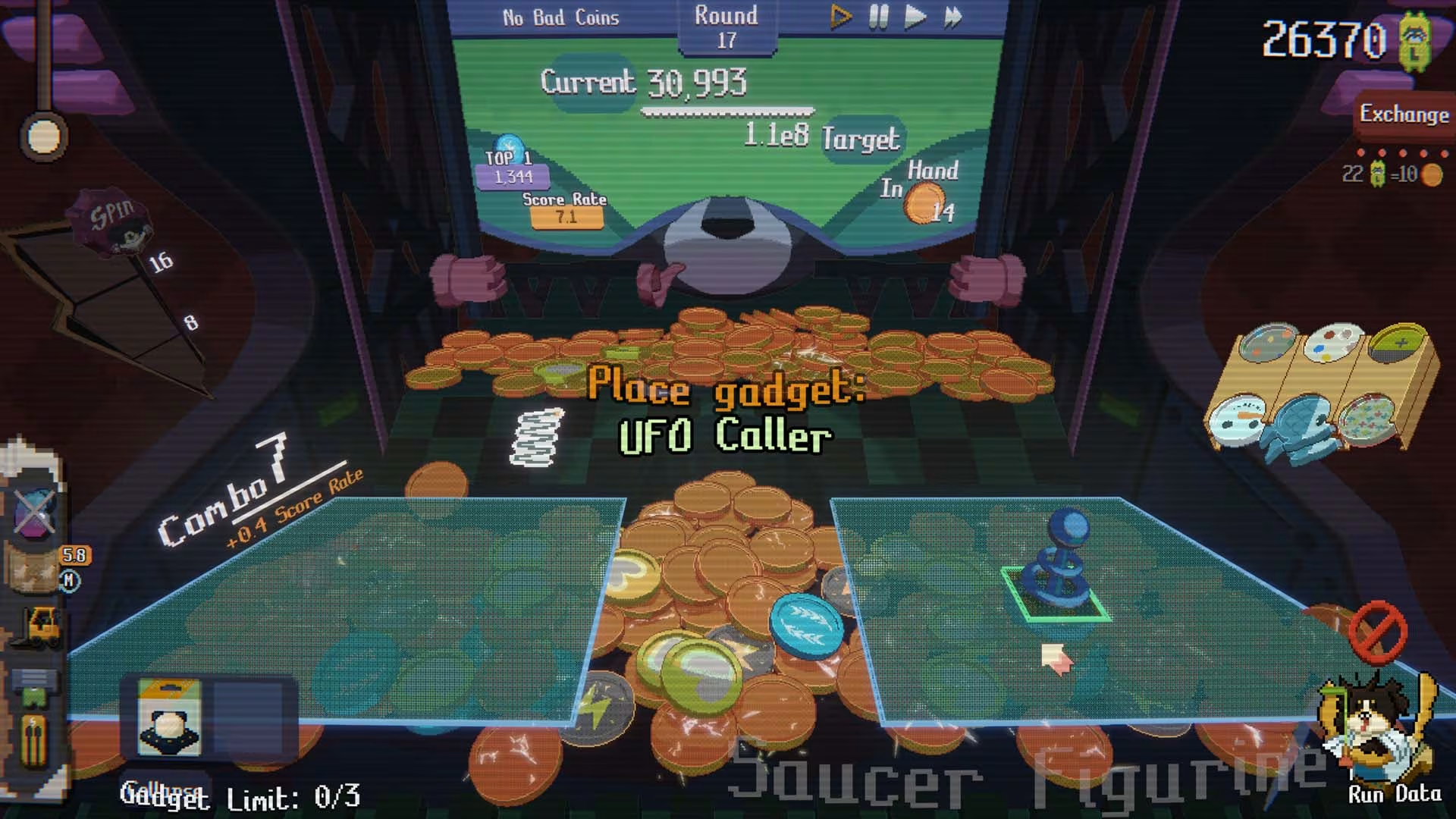
And RACCOIN: Chaos Max Edition is the console version of the “tabletop roguelike” from developers Doraccoon and publisher Playstack, who also published Balatro and DiceVaders. It’s a “physics-based deck-building coin-pusher roguelike”. If you don’t know what a coin-pusher is, it’s a casino machine filled with coins and prizes. You insert coins into the machine, and it drops them onto a pile. You hope those coins will help push the other coins or prizes until they fall off the board, and Raccoin is the “roguelike” spin on this machine.
As always (in this genre), your goal in Raccoin is to win all the rounds to conquer a specific run. In each round, you need to reach a specific quota of points. To achieve that, you will need to shoot coins into the pile and make them push other coins, so they fall into the “drop zone” and let you rack up points. But if you run out of coins and haven’t reached the quota, it’s game over for you, and you’ll need to start a new run from scratch.
The roguelike spin of Raccoin is that every round, you can buy Modified Coins that have a very specific effect on the machine or the other coins. For example, there’s a “sticky” coin that, when you drop it into the machine, makes all the coins around it stick to it, helping to push the other coins. If those coins drop, you gain more points. You can also buy Chips, which act as your modifiers, and each chip will have a permanent effect on your machine that will help you gain more points or make better use of your coin effects. And finally, you have your Prize Items. These are your consumable items that will have an instant effect, which can be either a subtle change, such as upgrading a specific type of coin on the board or gaining instant points, or something more chaotic like a hurricane, typhoon, or a bomb that can completely mess things up. So, that’s the mix that changes the gameplay, as you try to build your coins and chips to maximize your chances of conquering the final round.
The best thing about this specific genre is the potential for a good “arcade-y, just one-run experience”, where you don’t feel like browsing through your backlog and just want to play something to ease your mind, relax, or distract yourself while listening to a video essay or podcast. And Raccoin does that reasonably well. It’s a decent “time waster” that I liked turning on from time to time to try and win a run. So, as a “tabletop roguelike”, it delivers well enough on its premise.
Sadly, I don’t think it achieves its true potential, because Raccoin falls under one specific thing that I’m really not a fan of in some roguelikes, that kind of ruins the replay value for me, even though they’re one of my favourite genres. In my opinion, the best ones are not those that make it so hard to beat the game even on the easiest setup. That’s why I love Balatro and Ball x Pit: they get increasingly harder as you win more runs, because you unlock harder challenges, higher difficulties, different characters and starter decks, and the game challenges you to reach higher levels. But it doesn’t gatekeep you from winning in the early stages.
That’s one of the reasons I’m not a fan of games like Slay the Spire or Peglin. I think they have an insane difficulty spike between rounds, and it becomes frustrating just trying to win a single run. Raccoin basically has almost the same amount of content as something like Balatro. It has a lot of good stuff to unlock: more difficulties, more “coin decks”, more characters, and plenty skins for your machines. So it’s unfortunate that I don’t feel any incentive to keep unlocking more stuff because the difficulty spike in the later rounds is too high, and getting through a few winning runs really felt like a chore.
Also, Raccoin feels unbalanced and sometimes a little “too random” to win. Raccoin doesn’t have the biggest synergies for you to build your combos and stack points, despite what it seems to think it does. Most of the time, I was praying that a chip, coin, or prize that I liked would show up in the store so I could have a chance to win. I didn’t feel like I had as many different approaches to a run as Raccoin thinks I do. But that wouldn’t be the biggest problem if the difficulty spike wasn’t so big. I’ve loved simpler games in this genre, games that have half, or even less of the content Raccoin has, but I’ve been able to sweep their simpler gameplay under the rug because they felt nice to play. And if Raccoin had a more approachable difficulty, I would’ve liked it a lot more, and I wouldn’t have deleted already from my Switch 2 because I felt that I didn’t want to play any more runs.
Even after writing a full essay dunking on its problems, I still think RACCOIN: Chaos Max Edition is an okay game. I still played some runs while writing this review before giving up on unlocking more content. It’s a mildly fun experience, very easy to pick up and play. I just wanted it to be more merciful with its difficulty and have a much more balanced system, especially with its items and upgrades, so I wouldn’t have to keep searching for specific things just to have a slightly higher chance of winning. So, if you like this sub-genre, I’d recommend trying it, maybe what I disliked wouldn’t bother you as much as it did for me. But maybe play the demo first to see if you’ll like the it.
A chaotic and totally imperfect balance between a cinephile and a gamer.
Hello! My name is Murilo Bonassi! I’m from Brazil, and I’ve been a fan of both movies and video games for as long as I can remember. I grew up watching a lot of movies (especially horror movies), and my parents already had video game consoles in their homes even before I was born, so I was destined to be a fan of both media/art forms.
As for my “gamer” part, I’m a full-on retro gamer and Nintendo nerd, and how could I not be? My first video game console was the Super Nintendo, then my brother and I got the Nintendo 64, and when everyone had their PlayStation 2, we got the Nintendo GameCube. Alongside that journey, we also had all the Nintendo handhelds. As I grew up playing so much Game Boy Color/Advance and Nintendo DS, I became a “team-handheld” person. So, it’s a four-piece puzzle of how hard is it to solve when it comes to “why am I such a Nintendo nerd?”. And for the retro part, even though I had the privilege of having that many consoles, emulators are the reason I love all the franchises that I love. Every day, I play my “retro handhelds” to discover “good ol’ games” that might be a gem or at least just a pretty rock.
The most important part: I do not partake in console wars discussions. I am a video game fan, and it doesn’t even matter in the slightest where you play your games. What matters is that you play. So, that’s why I’m here on LifeisXbox, to share my love for this medium. I’ve written screenplays and hundreds of essays about movies and reviews for a very long time, and found my love of writing because of that. And now, I have an opportunity to write about my love for gaming. So, I’m taking you with me on this journey.