
I don’t know how to explain or convey this well, but in the late 2000s and early 2010s, the indie scene was quite different from what we have today. The mentality behind independent game development was still reminiscent of the golden era of web-browser gaming with Flash games, meaning games were much simpler in scope and even in design, with more of an arcade structure or a simple bite-sized adventure approach. Games like Hollow Knight were not the norm. Not taking anything away from those OG indie games. Au contraire, I still have a great deal of nostalgia and appreciation for them.
The reason I’m talking about that is that when I saw the launch trailer for Castlebound, from self-publishing developer Ogre Pixel, I ran as fast as I could to the Nintendo eShop to buy it, because the simplicity of the game’s idea and its presentation grabbed me. As a tower-defence-roguelite-platform-action-adventure hybrid with a Paper Mario book/sticker/cardboard-style design, it immediately got me interested, so I went in blind to give it a proper shot.
And now that I’ve properly finished the game, I can easily say Castlebound is one of the most fun and charming games of 2026, and I want to give it its flowers with this review.
So, let’s defend the castle and defeat the evil witch with our review of Castlebound.
ℹ️ Reviewed on Nintendo Switch 2 | This review is the personal opinion of the writer.
| Developer | Ogre Pixel |
| Publisher | Ogre Pixel |
Things I liked!
- Nothing beats a classic tale | In Castlebound, you are Lenora, an adventurer tasked with defeating an evil witch who wants to bring back an ancient evil to conquer the world. But the witch plans to do that using a living fortress that she and her grandfather have awakened. With the help of this ancient structure, she will have the power to defeat the evil foes spreading throughout the realm, while also having to protect the fortress from monsters that will try everything to destroy it and put an end to its powers.
And if you take the ancient living fortress aspect out of the narrative, the story is as simple as it gets: you are the hero, there’s the villain, and you go defeat the villain while adventuring and finding new friends and allies along the way, some of whom will become new heroes for you to choose from when going into battle. But the simplicity of the story is part of Castlebound’s charm. Since it’s presented like a cute pop-up book, this simple and earnest approach elevates the experience.
- Simple but creative gameplay | At its core, Castlebound is an auto-scrolling platform action game. You have five worlds to go through, and each one has several stages that you will have to complete in one go, leading up to a boss battle that marks the end of the level.
Each time you get to the end of a stage, you get a red or blue upgrade card, with Red Cards being general upgrades, like your health regeneration, or Blue Cards affecting your weapon, like upgrading your arrow to an exploding arrow. You need to choose carefully which upgrades you want to help you reach the end.
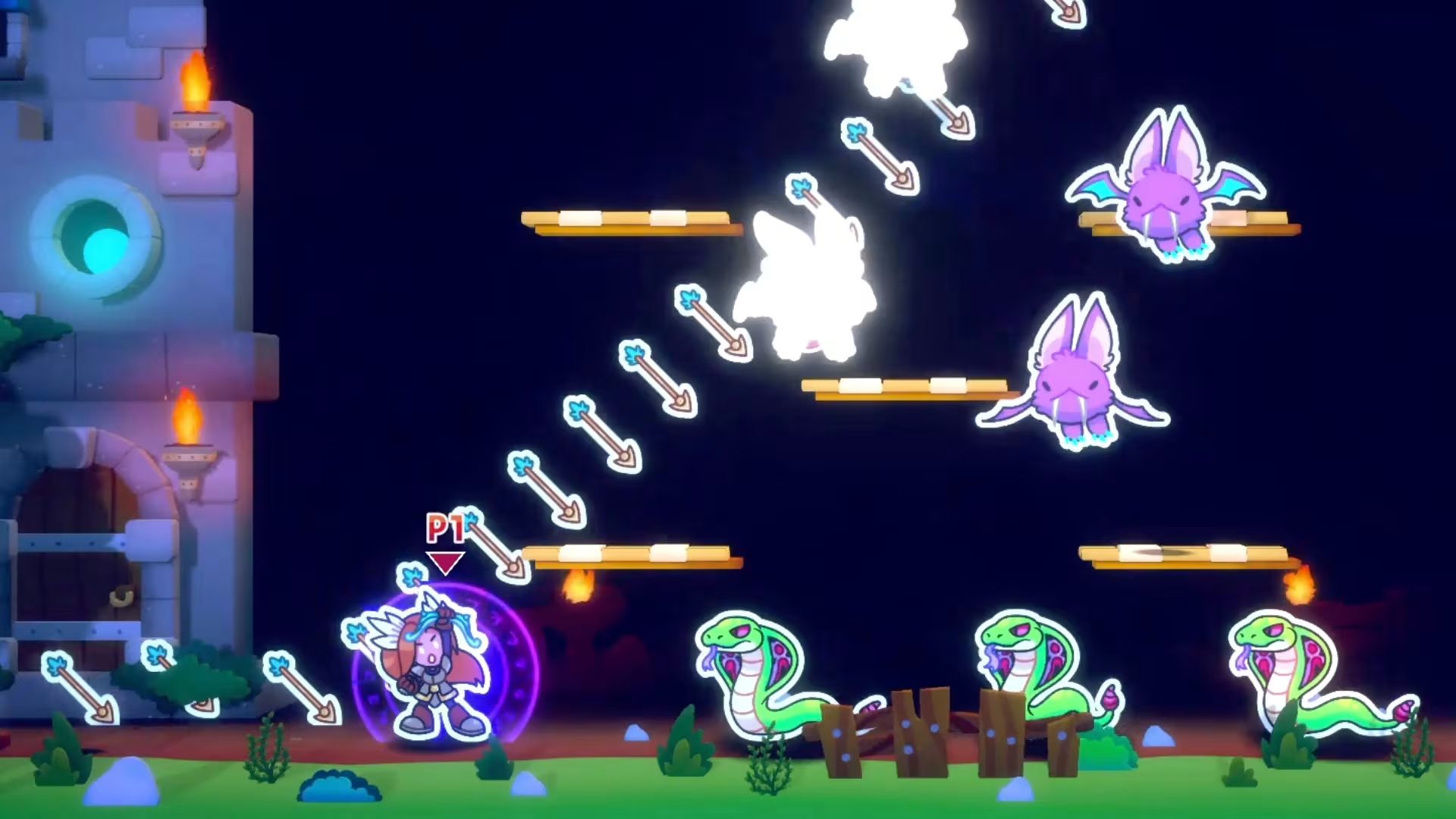
But the auto-scrolling part of the gameplay is really the best thing Castlebound has to offer. Even though it’s an action platformer, with you jumping across platforms, fighting a vast number of monsters and critters while trying to avoid falling into pits, the way you play it reminds me a lot of “shmups” (shoot ’em ups). Especially at the start, with Lenora the Archer, you are shooting arrows uncontrollably while there are hordes of enemies marching towards you.
And like most “shmups” or bullet-hell games, while you try to defeat every foe in your way, sometimes you feel it would be easier to just avoid some of the closer enemies to protect yourself. But that would work if there wasn’t the tower-defence element to it. If you fail to kill a monster, it will hurt the castle behind you, and if you let too many enemies get past you and your castle gets destroyed, it’s game over.
But you also can’t go “watch out, Mr. President” in front of all the enemies to protect the fortress, because your hero has their own health bar, so you need to watch both your hero and the castle. That means there are two ways to lose the game.
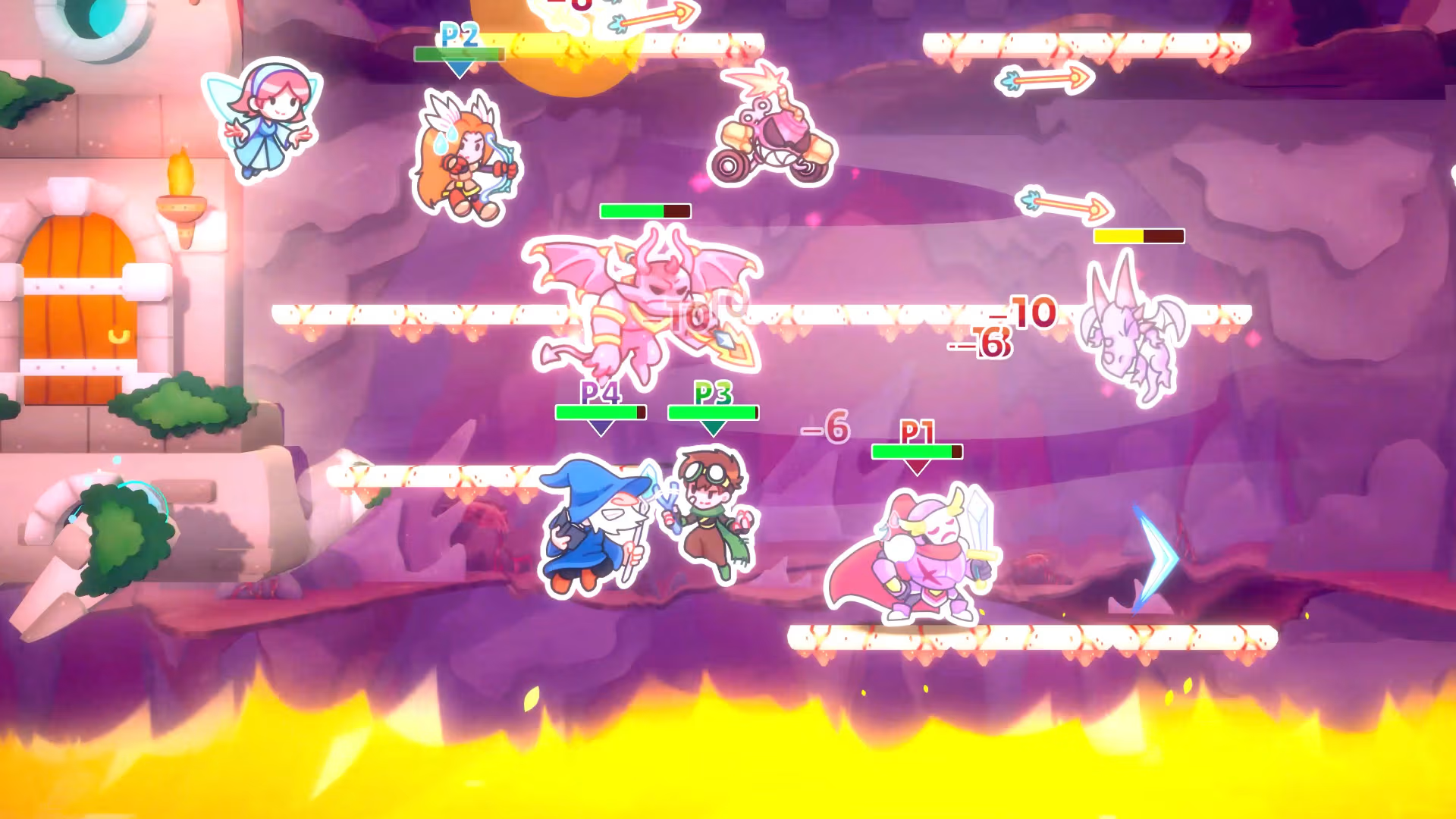
And that dynamic of constant attack and defence makes the whole experience of Castlebound different and special. It has a very frantic pace of action, and you are constantly looking at every part and corner of the screen, seeing if there’s an item for you to collect, if you let an enemy slip past you, or if there’s one getting closer. But being frantic doesn’t mean being chaotic or exhausting.
As contradictory as it might sound, Castlebound has a vibe of ease, like a “cozy” action game. That’s because the whole vibe and atmosphere of Castlebound reminded me a lot of older indie games. It’s so colourful and unpretentious, and even the monsters and critters are cute as heck. It’s a very huggable game, and that’s one of the biggest reasons why, while trying to beat all the stages, I couldn’t let go of Castlebound, because I’ve never felt tired of playing it.
- Choose your hero | Like I mentioned when talking about the simplicity of the premise and setting, the characters are really nothing grand to write about. They’re just really simple and charmingly cute heroes.
You’ll start with only Lenora, a very skilled archer, and along the journey, you’ll meet new allies who will have a funny introductory dialogue before becoming new heroes to play as, basically just another “new class” to use. You’ll have your standard mage, swordsman, or assassin. Pretty standard “medieval fantasy world” stuff, but Lenora and her bow and arrow will probably be the ones you’ll use the most before trying out new characters.
But each character plays very differently, and Castlebound wants you to carefully test each hero, because you unlock them one by one by completing some side quests that certain characters give you while playing a stage. By the end, I really wanted to keep playing as Lenora, firstly because she’s the character you start with, and you get used to playing with her before trying a new hero, and secondly because I thought she felt the best to play as. Nothing against the other characters, and you’ll probably like one more than I did, but her archery skills really brought home that “shmup” and arcade feel for me.
- Roguelite with progression | Castlebound is a roguelite, but with the “-lite” suffix in all caps and bolded, because it’s not your standard roguelite experience of “start from Level 1, survive and fight through all the stages, and then beat the final boss”, only to lose and “start again from Level 1, but stronger as you upgrade your heroes”. All the levels are separated by a level select screen, and when you finish a level, you’ll go back to the game hub, unlock the next world, upgrade your hero, and move on to the next level. Or you can replay a previous one to grind experience points (Soul Coins).
So, the “rogue” aspect of Castlebound is that every time you try to beat a world, it will be slightly different, with a different rotation of enemies and items appearing. But it’s the “-lite”-est possible version I’ve ever seen in a game of this genre. It’s a standard platform action game with a linear progression of stages, but the “rogue” aspect makes it easier to play or replay levels over and over again without feeling too repetitive, because it feels fresh every time you play.
Bringing in the “rogue” aspect to Castlebound and the level design was really the smartest move, because you will need to replay some stages to unlock new stuff and level up your character. But besides the world theming staying the same when you replay a stage, each attempt feels slightly different because of the rotation of enemies and items.
- A lot to unlock & play | The progression of Castlebound never ceases to give you new stuff each time you try to play a level. Whether you win or lose, you are always gaining Soul Coins, which serve as currency to unlock a variety of upgrades. You can use them as experience points to upgrade your character’s stats and skills, making them stronger or tougher, but you can also use them to unlock new Red or Blue Cards that will appear while playing a level. You can unlock costumes/skins for your characters, or new items that will appear in the shops you can find throughout Castlebound.
But Soul Coins are not the only thing that allows you to unlock tons of new stuff. There’s a very rewarding achievement system that acts as your side quests to complete while playing a specific level. Those achievements will help you earn new items and costumes that you can buy or upgrade in the other shops. And there’s a lot of different missions to do, mostly involving playing a certain stage with a specific character.
And every time you beat a level, you will basically unlock new stuff for you to do. Such as Arcade Mode, which acts as an “infinite survival mode”, allowing you to choose a stage and try to survive for as long as you can. You can unlock Hard Mode, which makes the enemies a lot stronger but increases the rewards, and by the end, you will also have a Boss Rush mode where you can defeat all the bosses in one run.
So, going back to the five-world structure, the core experience can be a little short if you just want to “beat the game”, but Castlebound does offer a lot more replay value if you want to continue and see more of what it has to offer. It can be a bite-sized adventure or a constant arcade experience that you will want to play from time to time.
- Seriously, everything’s cute | I don’t think that even if I reviewed Hello Kitty Island Adventure, I would use the word “cute” as much as I’m using it for this game, but Castlebound is seriously incredibly charming with its whole aesthetic.
As I briefly mentioned when talking about the visuals, it has a charming pop-up children’s book style. It’s very colourful, and every design wants to give off that “fun action game for the whole family” vibe. There’s nothing in this game that isn’t overwhelmingly cute. You have skeletons, dragons, zombies, giant and weird monsters, evil wizards and witches. It’s the whole Dungeons & Dragons bestiary, but Professor Utonium from the Powerpuff Girls added all the “everything nice” ingredients to the recipe. It reminded me a lot of Paper Mario, which I think was the biggest influence behind the whole “paper-cut characters and monsters” style.
And sound-wise, it was very neo-retro. Even though it’s not a pixel-art game, the soundtrack of Castlebound is very chiptune-inspired, and it reminded me a lot of the best retro-style indie games like Shovel Knight. All the tracks are very punchy and catchy, and they elevate the whole atmosphere of Castlebound.
Mixed & disliked!
- Maybe a little too easy? | Castlebound is an extremely approachable game. You can play it with friends, family, or even your kids. Like I said before, it’s an “action game for everyone”. You can make it harder with the unlockable Hard Mode, but as for the standard difficulty, I didn’t have much trouble beating everything. You’ll probably lose on your first attempt at the first stage, but it’s not hard to grind Soul Coins afterwards, so you’ll be pretty beefy and upgraded before long. I’ve probably lost 5 to 8 times before reaching and beating the final boss, and that’s not a lot by roguelike/roguelite standards. I’m used to being punched and kicked mercilessly by a roguelike game before I win any run or stage.
So, you could say Castlebound is “baby’s first roguelike”, but that’s not something I truly disliked. It’s just something I felt a little mixed about. I didn’t feel particularly challenged by Castlebound, but it was still a blast from beginning to end.
- Could’ve been more “rogue” | Like I mentioned before, Castlebound is very light in the “rogue” aspect, which is only present in a couple of elements, like the requirement that you must go from Stage 1 to the final stage of every world in one go. But those worlds are fairly short, and there’s also the rotation of some enemies, items, and upgrades that will appear. I would’ve loved it even more if maybe there were a couple of different bosses for each world instead of a flagship boss for each one, as that’s the only part that felt a little repetitive.
Also, even if I’m applauding its very approachable game design, I think a separate, classic “story arcade mode”, where you try to beat all the levels at once without dying, would be very fun and challenging, and would give Castlebound more replay value.
- How long did I play the review before publishing? 7 Hours
- How long to beat the story? Aprox. 3 to 5 Hours
- How long to get 100%? | Aprox. 10 Hours
- You’ll love this game if you like these | Tower Defense Games, Action Platform Games or Arcade Games in general.
Score: 88/100
Castlebound was a huge and quite random surprise. It was a blind pick from a launch trailer that I didn’t think much of, but by the end, I was completely in love with Castlebound. The mixing of action, platforming, tower-defence, and auto-scrolling arcade gameplay, with a roguelite flair to it, made it one of the most fun games of the year. And its colourful pop-up book style also made it one of the most charming games of the year.
It’s pretty bite-sized, and it won’t take long for you to beat the final stage, but sometimes we love our “simple candy-games” that will sweeten our day with their delicious simplicity. It’s a cute and honest game that will charm you until the end.
A chaotic and totally imperfect balance between a cinephile and a gamer.
Hello! My name is Murilo Bonassi! I’m from Brazil, and I’ve been a fan of both movies and video games for as long as I can remember. I grew up watching a lot of movies (especially horror movies), and my parents already had video game consoles in their homes even before I was born, so I was destined to be a fan of both media/art forms.
As for my “gamer” part, I’m a full-on retro gamer and Nintendo nerd, and how could I not be? My first video game console was the Super Nintendo, then my brother and I got the Nintendo 64, and when everyone had their PlayStation 2, we got the Nintendo GameCube. Alongside that journey, we also had all the Nintendo handhelds. As I grew up playing so much Game Boy Color/Advance and Nintendo DS, I became a “team-handheld” person. So, it’s a four-piece puzzle of how hard is it to solve when it comes to “why am I such a Nintendo nerd?”. And for the retro part, even though I had the privilege of having that many consoles, emulators are the reason I love all the franchises that I love. Every day, I play my “retro handhelds” to discover “good ol’ games” that might be a gem or at least just a pretty rock.
The most important part: I do not partake in console wars discussions. I am a video game fan, and it doesn’t even matter in the slightest where you play your games. What matters is that you play. So, that’s why I’m here on LifeisXbox, to share my love for this medium. I’ve written screenplays and hundreds of essays about movies and reviews for a very long time, and found my love of writing because of that. And now, I have an opportunity to write about my love for gaming. So, I’m taking you with me on this journey.